Nothing kills motivation on a weekend project faster than dropping a tiny screw and having to search for it using the flashlight on your phone. If you are still relying on a single, dim incandescent bulb swinging from the center of the ceiling, it's time for an upgrade.
Proper workshop lighting is about more than just brightness; it involves calculating the right lumens for your square footage, selecting the optimal color temperature for detail work, and strategically placing fixtures to eliminate shadows over your workbench.
Forget Watts, Focus on Lumens
In the old days, we bought lightbulbs based on watts (e.g., a 60-watt bulb). However, watts only measure energy consumption, not brightness. Since modern LEDs use a fraction of the energy of older bulbs, comparing watts is no longer useful.
Today, you must look at Lumens, which is the actual measurement of visible light output. The higher the lumen rating, the brighter the light.
How Many Lumens Do You Need?
The Illuminating Engineering Society (IES) has guidelines for different types of workspaces. For a typical residential garage or workshop, a good rule of thumb is:
- General Area Lighting: Aim for about 50 lumens per square foot (or roughly 500 lumens per square meter). This provides a bright base layer for parking and navigating the space.
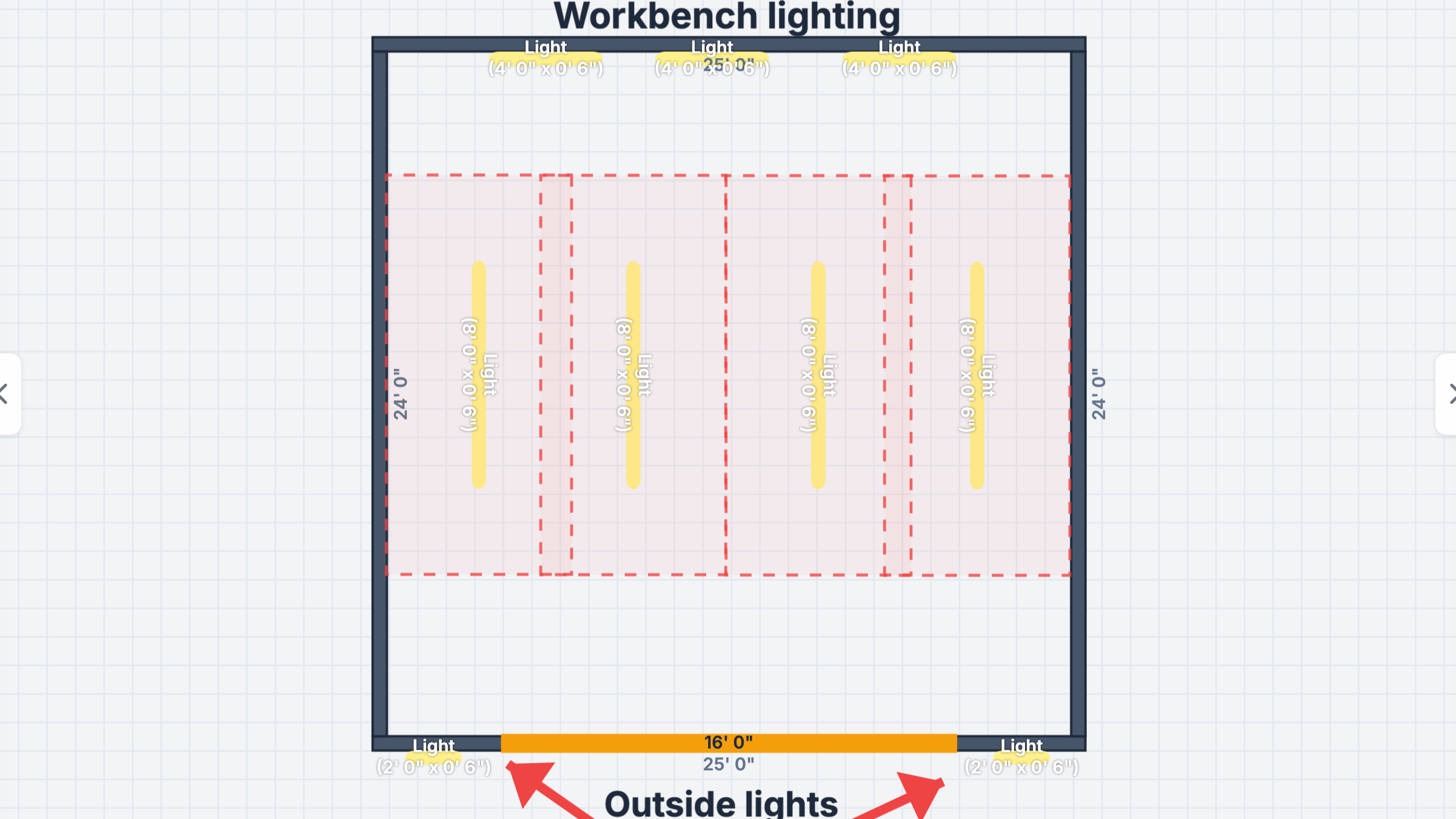
- Task Lighting (Workbenches): For detail work, soldering, or engine building, you need significantly more light. Aim for 300 lumens per square foot focused directly over the work surface.
Example: A standard 2-car garage is typically 24' x 24' (576 square feet). 576 sq ft × 50 lumens = 28,800 total lumens required for excellent general illumination.
Map Out Your Electrical Plan
Use our Garage Planner tool to drag and drop standard 110V and 220V outlets around your floor plan to ensure you have power exactly where your new shop lights and workbenches will go.
Start Layout DesignTypes of Garage Lighting
When outfitting a modern workshop, you generally want to employ a mix of three lighting types:
- Area Lighting: Usually provided by ceiling-mounted fixtures. Long LED shop lights (often resembling traditional fluorescent tubes) are currently the best bang for your buck. They offer wide, even distribution. High-bay LED UFO lights are an option if your ceilings are over 15 feet high.
- Task Lighting: Essential over workbenches or machinery. A dedicated LED strip light mounted directly above the bench eliminates shadows cast by your own body from the overhead area lights.
- Portable Lighting: Battery-powered LED work lights, under-hood lights, and magnetic puck lights are crucial for shedding light into tight engine bays or underneath vehicles where overhead lights can't reach.
Choosing the Right Color Temperature (Kelvins)
Color temperature is measured in Kelvins (K). The scale ranges from warm, yellowish light to stark, bluish-white light.
- 2700K - 3000K (Warm White): Cozy and relaxing, similar to an old incandescent bulb. Good for a living room, terrible for a garage.
- 4000K (Cool White): A nice balance. It feels brighter and cleaner but still inviting.
- 5000K (Daylight): This is the sweet spot for a workshop. It mimics natural midday sunlight. It provides excellent contrast and color rendering, making it easier to read fine print on labels or see subtle differences in wire colors.
- 6000K+ (Stark White/Blue): Very harsh and clinical. This can strain your eyes over long periods and is generally not recommended for home garages.
Placement Strategy to Eliminate Shadows
A common mistake is clustering all the lights in the dead center of the ceiling right where the garage door opener sits. When you pull a car in, the lights shine on the roof of the car, casting deep shadows everywhere else.
Instead, install your LED batten lights in parallel runs along the sides of where the vehicles park. For example, in a 2-car garage, run a line of lights over the left bay, a line down the center between the cars, and a line over the right bay. This ensures light hits the sides of the vehicles and illuminates the walking paths.
Fixture Count: From Lumens to a Shopping List
The lumen total only becomes useful once it is divided into real fixtures. A typical 4-foot LED shop light produces about 4,000 to 5,000 lumens, so a 576-square-foot 2-car garage needing roughly 28,800 lumens works out to six to seven linked fixtures for even general light. Task lighting over the bench is added on top of that number — the general layer is not expected to cover detail work.
Spacing follows the ceiling height: as a rule, keep parallel runs roughly 4 to 6 feet apart at an 8- to 10-foot ceiling, and space fixtures about the same distance along each run so the light overlaps rather than pooling. Higher ceilings need wider spacing but more output per fixture, which is where high-bay fixtures finally earn their place.
Then plan the switching in zones: general lighting on one switch, workbench task lights on another. Working with everything at full brightness is what makes a shop feel harsh, and being able to light only the bay you are using is what makes evenings in it pleasant.