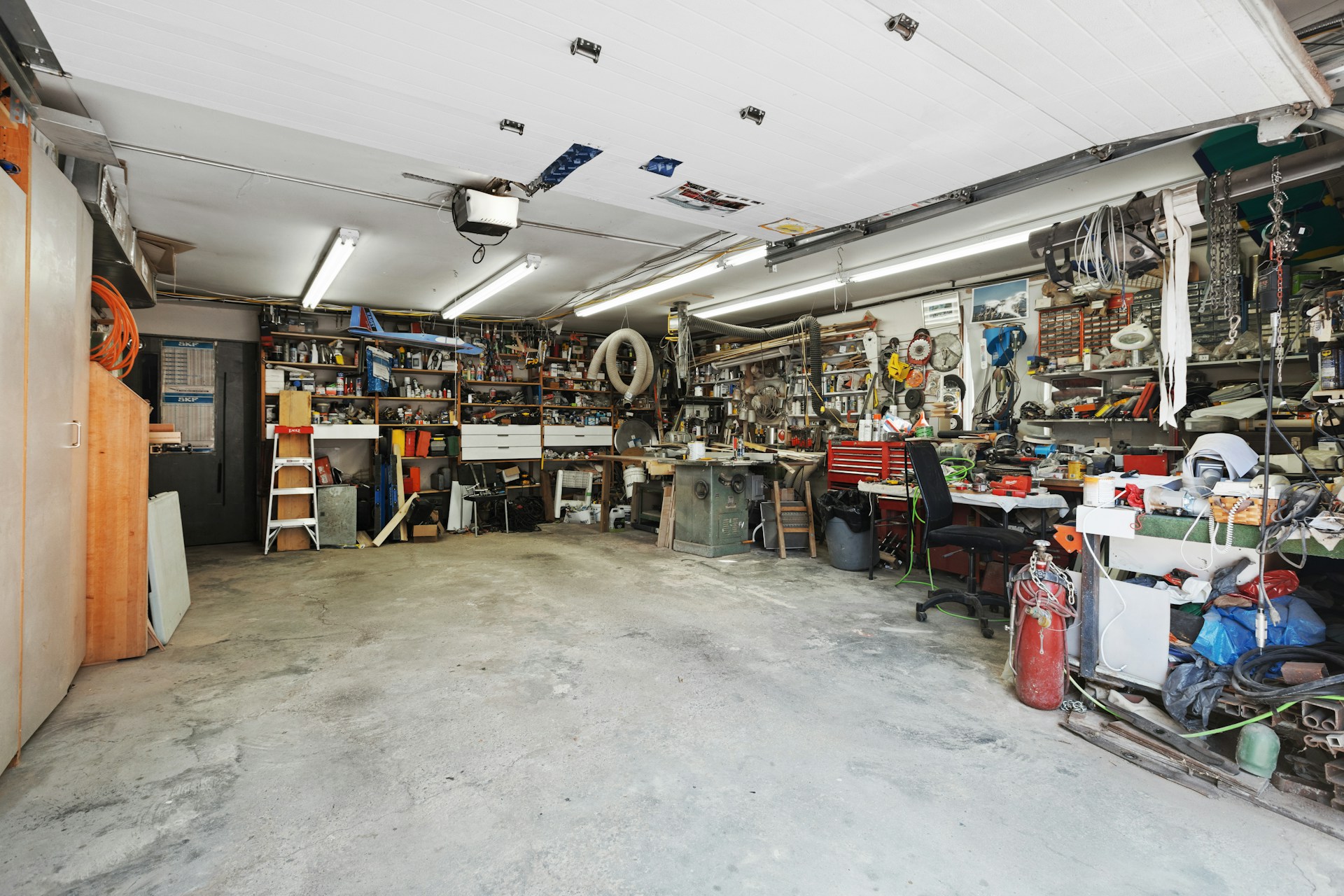
Storage is where good garage layouts die. A shelving unit is never "just a shelf" — it is a fixed object with a depth, a door-swing consequence, and a relationship to the garage door tracks that most people only discover when something doesn't close.
Shelf Depth: Choose by What You Store
| Depth | Best For | Placement |
|---|---|---|
| 12" | Bins, paint cans, small totes | Either side wall, even beside parked cars |
| 16" | Standard totes, small tools | Side walls with 24"+ walkway |
| 20–24" | Coolers, toolboxes, bins of bins | Back wall or end walls only |
| 24"+ | Workbench-depth storage, cabinets | Back wall, never beside a car door swing |
The rule that matters: the depth of the shelf must fit inside your walkway budget. If your side walkway is 30 inches and you install a 16-inch shelf, you are down to 14 inches of walking space — less than a shoulder's width. Our guide on bay width and door swing explains how to measure that budget precisely.
The Garage Door Track Zone
The most-violated clearance in garage design: the vertical track and door travel zone. A sectional door rises along the side walls and back across the ceiling:
- 4 to 5 inches per side beside the door opening is track territory — no shelving, no hooks, no ladder ends.
- The top 12 to 15 inches of the opening height is where the door travels horizontally — anything mounted on the wall above the door opening must clear the highest point of the door arc.
- In front of the opening on the ceiling, the opener rail claims roughly the middle of the bay for the length of the door plus the rail. Overhead racks fit between the rail and the wall, not through it.
Overhead Racks: Height Math
Ceiling racks are the best storage in any garage and the most annoying to place. Working numbers:
- Bottom of the rack at least 48 inches off the floor if cars park under it (roof clearance plus margin for roof boxes and antenna guilt).
- With an 8-foot ceiling and 7-foot door, the only safe zone is usually in front of the opener rail, near the header. With 9 or 10-foot ceilings, full racks above parked vehicles become practical.
- Rated loads are 250 to 600 lbs for typical racks — but that is the rack, not your ceiling joists. Lag into trusses or add blocking.
A Storage Layout That Actually Works
- Shallow (12–16") shelving on both side walls behind the parked vehicles' door arcs.
- Deep storage (24") on the back wall where the car's hood is anyway.
- Ceiling racks over the vehicle bays (never over the walkway to the house door — ladder work overhead of your daily path is how heads get dented).
- A 36-inch clear path from the house door to the vehicles, always, in every season.
Shelves Are Objects — Place Them
Our planner includes shelving, cabinets, and clearance zones, so you can see exactly what a 16-inch shelf does to your walkway.
Open Free Garage PlannerFinally, match storage to utilities: keep the code-required 30-inch service zones around electrical panels, furnaces, and water heaters permanently empty. If those appliances share your garage, our heating guide and electrical guide explain where they land on the wall.
Wall Systems, Cabinets, or Racks: Matching Storage to the Wall
| System | Depth | Best Use |
|---|---|---|
| Slatwall or track with hooks | 1–2" off the wall | Hand tools, cords, and bikes — the least depth-consuming option |
| Freestanding shelving | 12–18" | Totes and bins; cheap, movable, and easy to reposition as the garage changes |
| Wall cabinets | 12–14" upper, 24" base | Clean, dust-free storage for paint, chemicals, and small parts |
| Heavy-duty racking | 24–48" | Bulky long-term storage on the back wall, rated for real weight when anchored |
Whichever you choose, check the load rating and how it attaches. A shelving unit holding 500 lbs of paint cans is a wall of falling bricks if it is not anchored into studs or a properly rated track system.
Vertical Storage: Getting Things Off the Floor
Floor space is the resource your cars need; wall and ceiling space is what your stuff needs. The highest-value moves lift awkward, bulky items out of the path of doors and bumpers:
- Bikes: a hook at 6–7 feet keeps the floor clear and needs about 2 feet of wall per bike, but the wheel-to-wall depth means you still need 24 inches of standing room to hang and remove them.
- Ladders: hang them horizontally above head height, or on ceiling hooks parallel to the garage door travel. Never across the walkway to the house door.
- Seasonal gear: kayaks, roof boxes, and holiday bins are the best candidates for ceiling storage above a parked vehicle, because you touch them twice a year.
- Shovels, rakes, and hose reels: one shallow track along an end wall, positioned so it never overlaps a door swing or the 30-inch zone in front of an electrical panel or water heater.
The test for any vertical mount: stand where you would actually be standing when you reach for it. If that spot is inside a car door's arc or under the garage door's travel path, the item is in the wrong place — no matter how tidy it looks. And if a hook has to hold anything heavier than a garden tool, put it into a stud, not into drywall anchors.