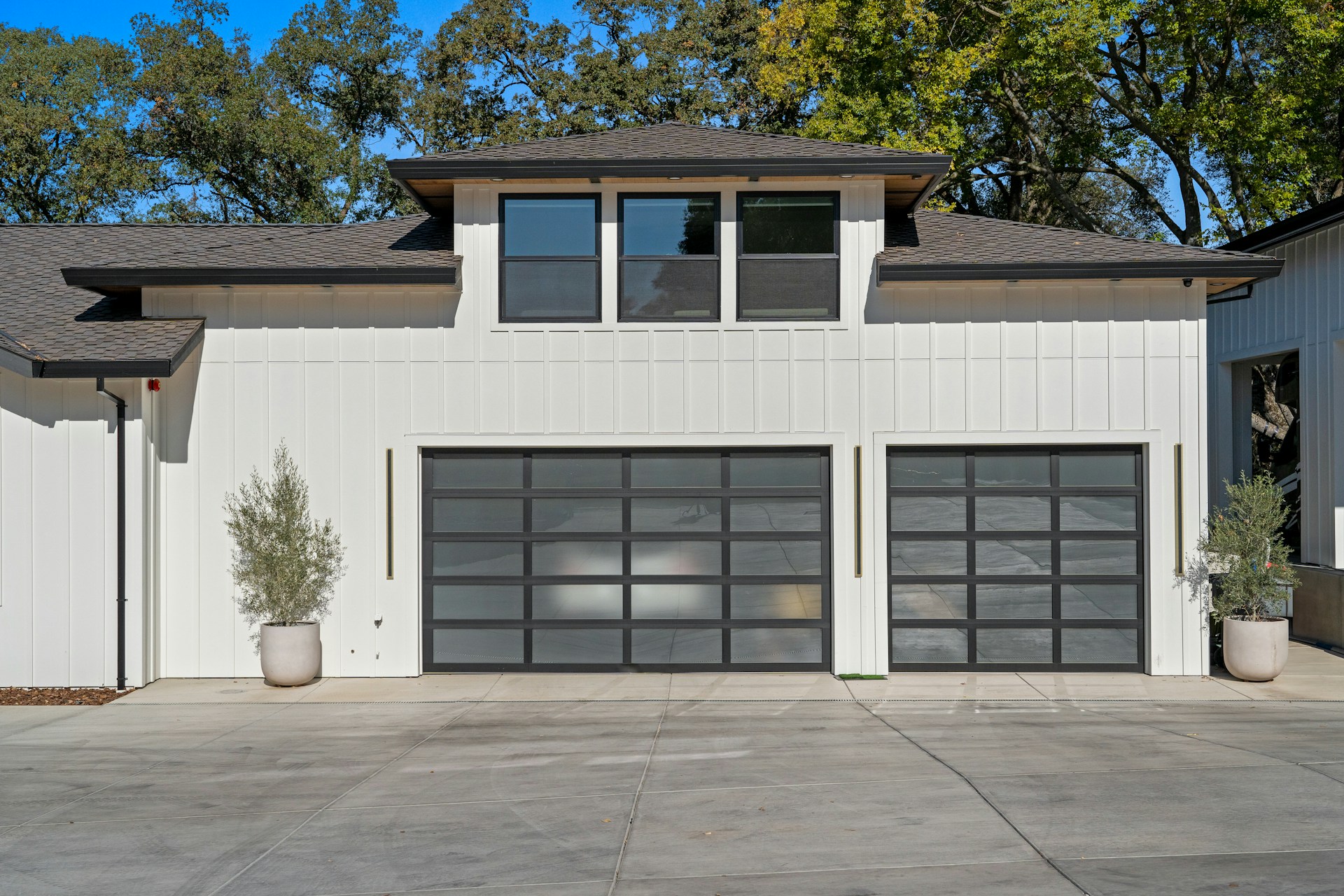
The garage door is the one part of a garage you cannot easily change later. Order the wrong size and you either frame a new header or live with a door your truck barely clears. Here are the standard sizes and the framing numbers behind them.
Standard Garage Door Sizes
| Door Width | Type | Typical Vehicle |
|---|---|---|
| 8' | Single (legacy) | Compact cars only |
| 9' | Single (current standard) | Sedans, small SUVs |
| 10' | Single (oversized) | Full-size trucks and vans |
| 12' | Single (large/RV-adjacent) | Large vans, small boats |
| 14'–16' | Double | Two vehicles, one opening |
| 18' | Double (oversized) | Two full-size trucks comfortably |
Most residential doors are 7 feet tall. Eight-foot-tall doors exist for lifted trucks, campers, and taller SUVs, and are worth specifying in new construction — the framing cost difference is small.
Rough Openings: The Number Builders Actually Use
A "9-foot door" does not go in a 9-foot hole. The rough opening should be the same as the door size — 9' × 7' for a 9' × 7' door — because the door's own mounting flanges sit inside the framing. What trips people up:
- Header height: the rough opening's top is at 7'1" for a 7-foot door, plus the header itself above that. Plan the lintel, not just the hole.
- Side room: torsion-spring doors need roughly 3.75 to 4.5 inches of side room per side for the vertical track and spring assembly; extension-spring doors need more like 5 inches.
- Headroom: standard track needs 12 to 15 inches above the door opening; with an opener, figure 12 inches of opener rail above the highest point of the track travel, though jackshaft and low-headroom kits reduce this to as little as 5 to 6 inches.
- Between double doors: two single doors side by side need at least 4 inches of framing between openings for both track sets.
Sizing for What You Drive
The door only has to clear the vehicle — the garage has to clear the driver. But both matter:
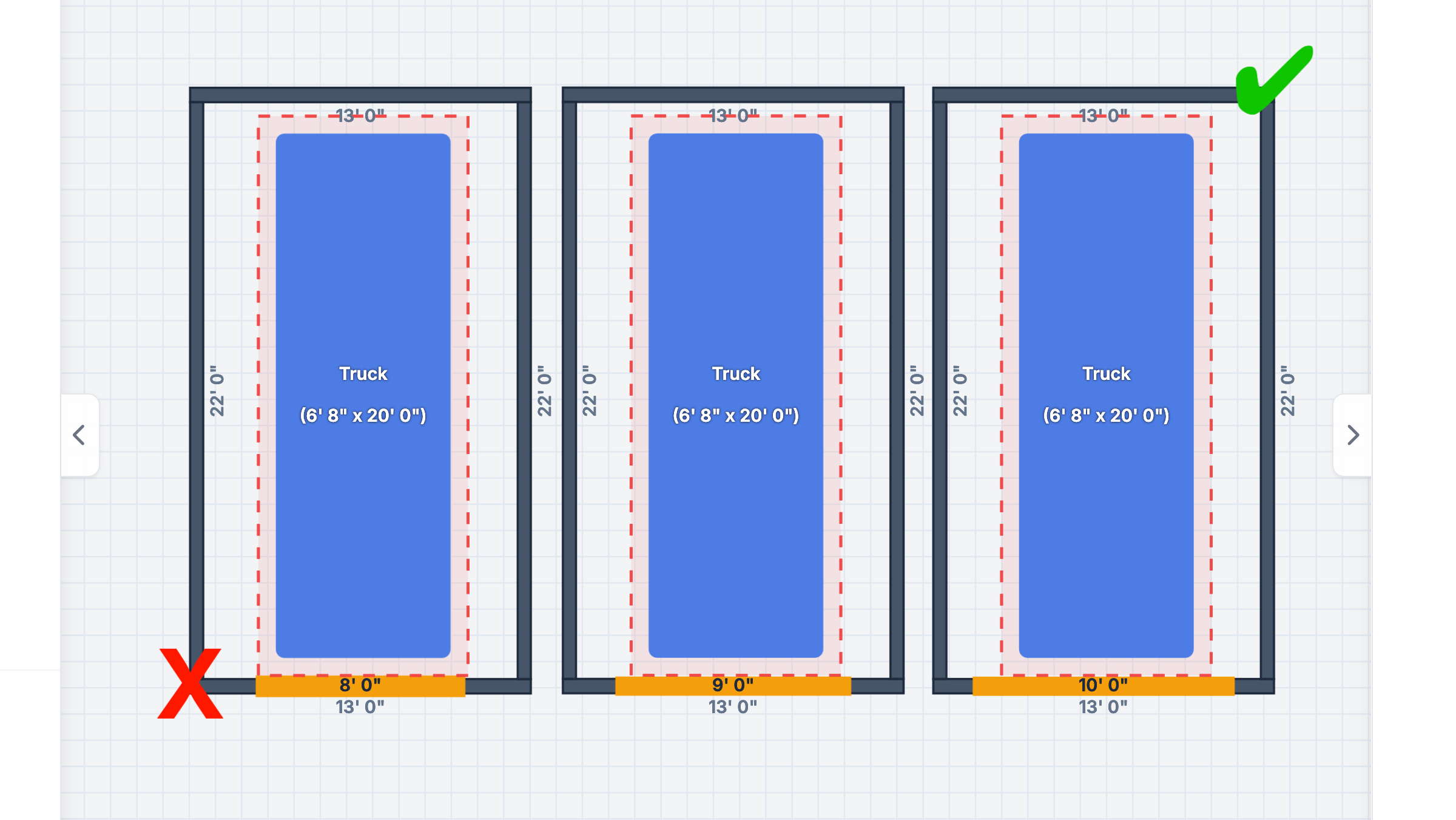
- A 9-foot door over a 6'8"-wide truck leaves 14 inches of total margin. You will fold the mirrors in more often than you would like.
- A 10-foot door is the comfortable choice for any full-size truck, and it is what we recommend for any new single bay.
- For doubles, two vehicles each under 7 feet wide fit through a 16-foot door; an 18-foot door removes the "who pulls in first" problem entirely.
Our guide on garage bay width covers how door size and bay width interact with door-swing clearance.
Non-Standard Situations
- RV doors: typically 12' to 14' wide and 12' to 14' tall — measure your rig's roof AC and ladder, not just the body height.
- Older homes: 7' × 6'6" doors were common pre-1990; replacements are still catalog items but limit modern vehicles.
- Golf cart and shed doors: 5' × 6' is the common small size.
Draw the Opening Before You Order
Place your vehicle and the door in a scaled plan to check clearance on both sides — free, no account needed.
Open Free Garage PlannerWorked Example: Sizing a Door for an 80-Inch Truck
A full-size truck body is roughly 80 inches wide, and with the mirrors extended it sits close to 94 inches. The door opening has to clear 80 inches to be a functional fit, but the mirror margin is what makes it pleasant:
| Door size | Clear opening over 80" body | Mirror margin (folded at 6'11" = 83") | Verdict |
|---|---|---|---|
| 8' (96") | 16" total | 13" (mirrors folded) | Pulls in OK folded, nerve-racking daily |
| 9' (108") | 28" total | 25" (mirrors folded) | Workable, but mirrors get folded every time |
| 10' (120") | 40" total | 37" (mirrors folded) | Comfortable; mirrors stay extended |
Most homeowners over-focus on the body width and under-weight the mirror arc. The spec sheet says the truck is 80 inches, but the mirror at the A-pillar adds a whole foot of vulnerable glass on each side at about the height of the door jamb. A 10-foot door is the sweet spot for any full-size pickup — it is the difference between "it fits" and "I don't need to hold my breath pulling in."
Rough-Opening Gotchas Most Builders Hit Once
- The header flush with the top of the opening adds unusable height above the door — raise it a full "lintel height" above the rough opening so the track and opener have headroom.
- Side room for modern torsion springs: the vertical track needs roughly 3.75–4.5 inches each side; skimp and the door rubs on install or service is a cramped nightmare.
- Min 18 inches between the door's highest arc and the ceiling: this is what lets the opener rail and belt sit above the door instead of sagging into the bay.
- Brick mold returns: if you're bringing an existing brick/vinyl facade to the opening, the rough opening usually grows ~1.5" each side for flashing and trim.
Frequently Asked Questions
Is an 8-foot-tall door worth the upgrade? If any vehicle has a roof rack, camper shell, or lift kit — or you plan a car stack later — yes. The framing cost delta is small during construction (a higher lintel), but a retroactive 8-foot door means rebuilding the header, blocking, and track setup.
What size door do I need for a 2-post lift? The lift doesn't define the door, the tallest vehicle on the lift does. A sedan on a 2-post at full rise clears a 7-foot door in most 9- to 10-foot-ceiling garages; a truck needs the taller opening. See our home garage lift guide for the full ceiling-height math.
Can I use a 16-foot door where two 9s were planned? Yes, if the opening width and side-headroom work with a single 16-foot lintel. It trades three motors for one and cleans up the facade — just confirm the header span is engineered for the wider opening.
The Takeaway
For new construction: 10' × 7' singles (8' tall if any truck will live there), 16' or 18' doubles, and frame the rough opening at exactly the door size with 12–15 inches of headroom for the track and opener. For everything else in the garage — bays, lifts, storage — see our guides on 1-car and 3-car garage dimensions.